Quranic Foundation: Why Zakat is Non-Negotiable
Before we talk about amounts or percentages, we need to look at what Allah’s Book actually says about zakat. The Quran does not speak about zakat as an optional act of kindness; it is a fundamental obligation repeatedly paired with prayer.
Establish prayer and give zakat:
Quran 2:43
“And establish prayer and give zakat and bow with those who bow.”
The reward with Allah:
Quran 2:110
“And establish prayer and give zakat. And whatever good you put forward for yourselves—you will find it with Allah.”
Purification of wealth and soul:
Quran 9:103
“Take from their wealth a charity by which you purify them and cause them increase…”
Allah made zakat an obligation. But the question is: How does Allah tell us to calculate or give it?
When people asked the Prophet what they should spend, the answer in the Quran was direct:
Quran 2:219
“They ask you what they should spend. Say: the excess.”
The Quranic word used here is al-ʿafw, which means the excess, surplus, or what is beyond one’s immediate needs.
Hadith limitation of the zakat
People constantly ask: “How much zakat should we give?“
The answer most Muslims have been taught is simple: 2.5%. But where does that number come from?
If you go to the Quran, you will not find a verse saying that zakat must always be 2.5%.
But this raises a bigger question: if Allah did not give us this percentage in the Quran, are we supposed to take religious rules from sources outside His Book? I wrote more about this in Does the Quran Tell Us to Follow Hadith?
At the same time, I don’t want to give the impression that zakat itself is optional or simply another word for charity.
Giving only 2.5% from what we have from our wealth is a stinginess invented by Hadith.
Allah constantly commands us to establish prayer and give zakat, and the Quran repeatedly shows us how important giving is.
This is something I want my children to understand from a young age.
Not because I want to teach them complicated religious calculations, but because I want them to understand what it means to give to others, to recognize what is in excess, and to trust Allah.
And recently, something very simple happened that made this verse come alive for me and I will show you how I explained to my children about zakat, about how we should calculate it and how important it is to be generous and give.
Keep reading, this example will help you too to know how zakat should be calculated and what it actually means.
What Does “The Excess” Mean?
⚠️ Disclaimer: The following story from the zoo is a simple, real-life example meant strictly for children, to teach them the basic concept of sharing and generosity. The grass we gave was an act of kindness, not actual zakat. Children do not have the obligation of zakat. For adults, however, this principle of looking at what is ‘extra’ or ‘in excess’ serves as a reflection for when we evaluate our own wealth and responsibilities.
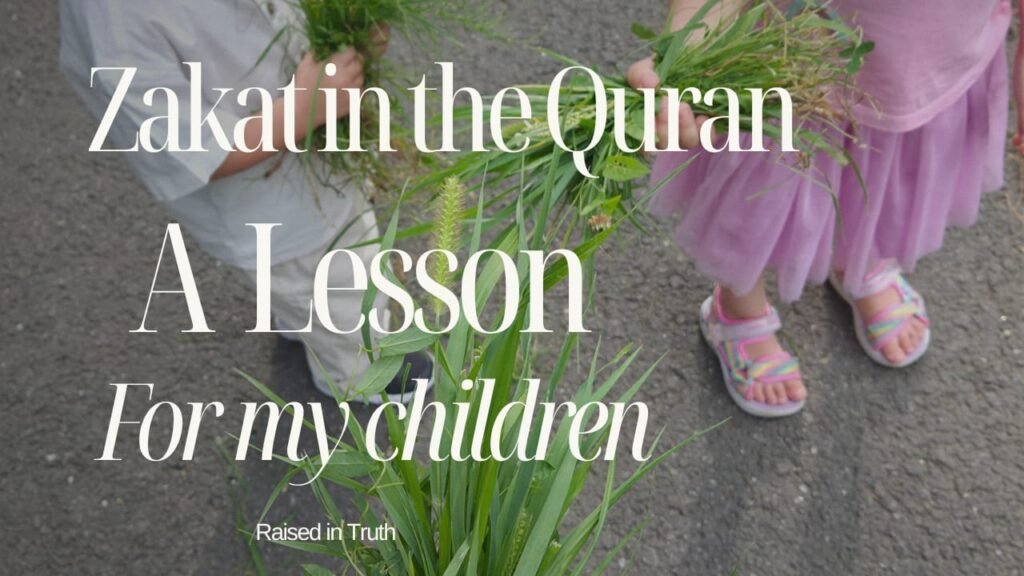
Today we went to the zoo. There was an area where the children could feed some of the animals, so I picked a handful of grass for each of my children so they could feed the animals with their own hands. Then I picked another large handful of grass and kept it with me. That was extra.
My children already had grass in their hands. They had what they needed to feed the animals, while I was holding more than they needed at that moment.
Then I noticed other children who were also excited about feeding the animals, so I gave them the grass I was holding.
My children still had what they needed, and I gave away what I had in excess. It was such a simple moment, but it made me think about what I want my children to understand about giving.
I told them that Allah tells us to give from what is in excess, and that this is something we should learn to do instead of constantly keeping things for ourselves.
We don’t need to constantly stock up because Allah is the One who provides what we need, and we trust Him.
If something is truly in excess, keeping it simply because we are afraid that we might need it later it means we don’t trust the One who provide us with everything.
What happened afterwards made the lesson even better. Did we need more grass? Yes. So we simply went and picked more—as much as they wanted. The children I had given the grass to also picked more themselves.
Sometimes we hold onto everything out of fear of the future. But teaching children to recognize what is in excess, rather than clinging to everything out of fear.
The grass I gave those children was not literally a zakat payment, and I don’t want to confuse the example with the actual obligation of zakat. The point of this story is that this is how I am beginning to teach my children to understand what they should look at when they eventually have to calculate zakat for themselves.
Of course, life is not always as simple as picking another handful of grass, and I am not saying that we should give away everything we have and assume that we will immediately receive more. We have responsibilities towards ourselves and our families, and we should use wisdom. But I do want my children to understand that constantly keeping everything because of fear of the future is not the kind of trust in Allah that I want to teach them.
And this makes me think about how Allah places people and circumstances in our lives. We don’t always know why someone asks us for something at a particular moment, but perhaps that moment itself is part of the test. Allah knows what we have, Allah knows what we need, and Allah knows what the other person needs.
How I Want My Children to Understand Zakat
I want this way of thinking to become natural to my children long before they are adults with their own wealth.
When they are small, they can understand it through something as simple as grass at the zoo. They can see that they have something in their hands, that they have enough for themselves, and that when they have more than they need, they can give some of it to someone else.
Later, when they have money and possessions of their own, the same principle can become much more meaningful. They will have to look at what Allah has given them and ask what they genuinely need and what is in excess, while also understanding the Quranic categories of people and situations for whom zakat is intended.
This is why I don’t want to teach them that zakat is simply about finding the smallest amount they are allowed to give.
I want them to understand that zakat is an obligation from Allah and that wealth itself is a test. Allah has given us what we have, and He asks us to give from it. The Quran repeatedly connects prayer with zakat, and it also describes successful believers as those who are observant of zakat.
So for my children, I want the lesson to begin much earlier than a cheap percentage from Hadith. I want them to grow up understanding generosity, responsibility and trust in Allah, so that when they eventually have to calculate zakat for themselves, they are not looking for the minimum amount they can give while keeping everything else out of fear. They will already understand the question I want them to ask:
What has Allah given me, what do I truly need, and what is in excess?
That is the lesson I was trying to teach them with that handful of grass.
I want them to grow up knowing that Allah is the One who provides, that wealth is a test, that giving is an obligation, and that generosity should not come from fear or from trying to find the smallest amount they can get away with giving.
Who Is Zakat For? According to the Quran
When it comes to fulfilling this obligation, the Quran doesn’t leave us guessing about who is eligible to receive zakat. Surah At-Tawbah gives us the exact, complete categories:
“Zakat expenditures are only for the poor and for the needy and for those employed to collect [the zakat] and for bringing hearts together [for Islam] and for freeing captives [or slaves] and for those in debt and for the cause of Allah and for the [stranded] traveler – an obligation [imposed] by Allah. And Allah is Knowing and Wise.”
Quran 9:60
The Quran outlines these specific groups, showing us that zakat is not. an arbitrary tax or simply a yearly calculation. It is a system Allah established to direct wealth towards people and causes He specifically identified.
Conclusion: What I Want My Children to Remember
I don’t want my children to grow up seeing zakat as just a cheap calculation or a number they pull out once a year because they were told that Allah requires them to give 2.5% of their wealth. The Quran never gives a 2.5% calculation. That number comes from later religious tradition, not from Allah’s Book.
I want them to grow up knowing that:
- Wealth is a test from Allah.
- Giving is a clear obligation commanded alongside prayer.
- Generosity should come from gratitude and trust in Allah, not from fear or trying to find the absolute minimum they can get away with giving.
This is also why I want my children to learn to go back to the Quran themselves, rather than simply accepting every religious rule they hear from other people. I wrote more about how I came to this way of understanding Islam in Quran Alone Is Sufficient: A Journey to Truth
When they are adults, they will look at what Allah has provided, fulfill their responsibilities to their families, look at what genuinely remains in excess, and direct it to the categories Allah defined in His Book.
That is the lesson I want them to carry: not just how to use a calculator, but how to trust Allah with what is in their hands.
Pingback: Does the Quran Command Muslims to Follow Hadith? -