Most of us never think to ask this question. We grow up hearing it, and it sounds completely natural, even holy, to say: “You must follow the Quran and the Hadith.”
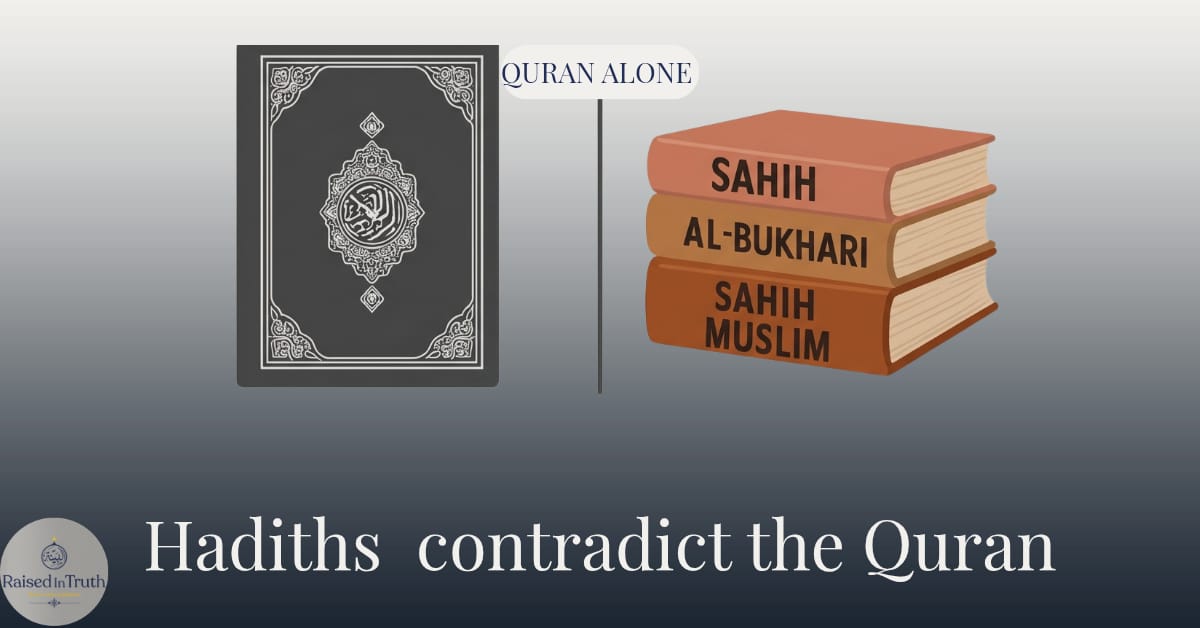
But have you ever stopped to look for the source of this obligation? Check my article about Hadiths contradiction.
The question is simple, but it shakes the very foundations of traditional belief: Did Allah ever command us to follow Hadith?
Not what people say. Not what scholars have repeated for centuries. But what Allah actually revealed in His Book.
What Does the Quran Actually Command?
The Divine message is direct. It doesn’t leave room for guesswork:
6:106
“Follow what has been revealed to you from your Lord.”
“I only follow what is revealed to me.”
10:15
The command is always the same: Follow Revelation. Nowhere does Allah mention a need for extra-quranic narrations—collected hundreds of years after the Prophet—to “complete” or “explain” His message. If the Revelation were incomplete, Allah would have told us.
The Word “Hadith” in the Quran
This is where most people are stunned. The Quran actually uses the word “hadith” itself, but look at the context in which Allah uses it:
7:185
“In which Hadith after it (the Quran) will they believe?”
“These are the verses of Allah… then in which Hadith after Allah and His verses will they believe?”
45:6
“Then in which Hadith after it will they believe?”
77:50
Read those verses again carefully. Allah isn’t telling you to go out and find the “authentic” Hadith. He is asking a rhetorical question: Why would you ever feel the need for anything else besides My Word?
Are the 5 Pillars of Islam Found in the Quran?
We are taught from childhood that Islam is built on “The 5 Pillars.” It is the very first lesson in religion. But have you ever wondered where these 5 pillars appear together as a mandatory structure?
If you read the Quran from cover to cover, you won’t find them. The famous “5 Pillars” come exclusively from Hadith.
Let’s look at the reality:
- Shahada (as a specific formula for joining) → Found in Hadith.
- Salah (the specific details of 5 daily prayers) → Found in Hadith.
- Zakat (the fixed 2.5% percentage) → Found in Hadith.
- Fasting (the specific start/end mechanics) → Found in Hadith.
- Hajj (the detailed rituals) → Found in Hadith.
Think about the weight of this: The entire practical base for “submitting” to Allah is not found in His Book, but in narrations written long after the revelation.
How can we say we truly submit to Allah when everything we know about “practicing” our faith comes from a source other than His Book? If the pillars of your house are not anchored in the ground of Revelation, but in the sand of human tradition, how secure is your home?
So, Where Did It All Start?
If Allah never commanded it, where did this belief come from? It came from people. From traditions. From generations who, in an attempt to “regulate” every aspect of life, added layer after layer on top of the original message.
Over time, these layers of dust fossilized. We started calling the dust “religion” and forgot the diamond underneath.
The Reality Most People Avoid
People often say: “We follow the Quran first.” But look at how religion is actually practiced today. If your laws, your daily rituals, and your view of women are dictated by narrations outside the Quran, who is truly “first” in your faith?
Is it the Quran… or the system built around it?
“But how would we know how to pray?”
This is the most common objection. Many will say that these rules were only transmitted orally or through Hadith, and that without them, we wouldn’t know how to submit to Allah.
But what if I proved to you that every essential detail is already in the Quran?
The truth is, Allah describes His Book as “complete” and “clear.” The details are there, but we have been conditioned to look for them in the wrong places. To find them, we have to truly read the Quran—not just recite it—and pay close attention to what Allah is actually saying.
Are you ready to see for yourself?
I am preparing the next deep-dive articles to show you exactly where the Quran defines these foundations. Which one do you want to learn about first?
- Shahada
- Salah
- Zakat
- Fasting
- Hajj
Write in the comments which one you’re most curious about! I’ll start with the topic that gets the most votes.
Final Reflection
This is not a small question. It defines your entire relationship with the Creator. If Allah did not command something to be part of your religion, why are you giving it that power?
The choice is yours:
– Are you following what was revealed?
– Or are you following what was added later?
Raised in Truth — Back to the source. Back to the Quran.
Pingback: What Does “Obey the Messenger” Really Mean in the Quran? - Raised In Truth
Pingback: Can Islam Be Corrupted Like Christianity and Judaism? - Raised In Truth
Pingback: Zakat Explained: Giving from Excess According to the Quran - Raised In Truth