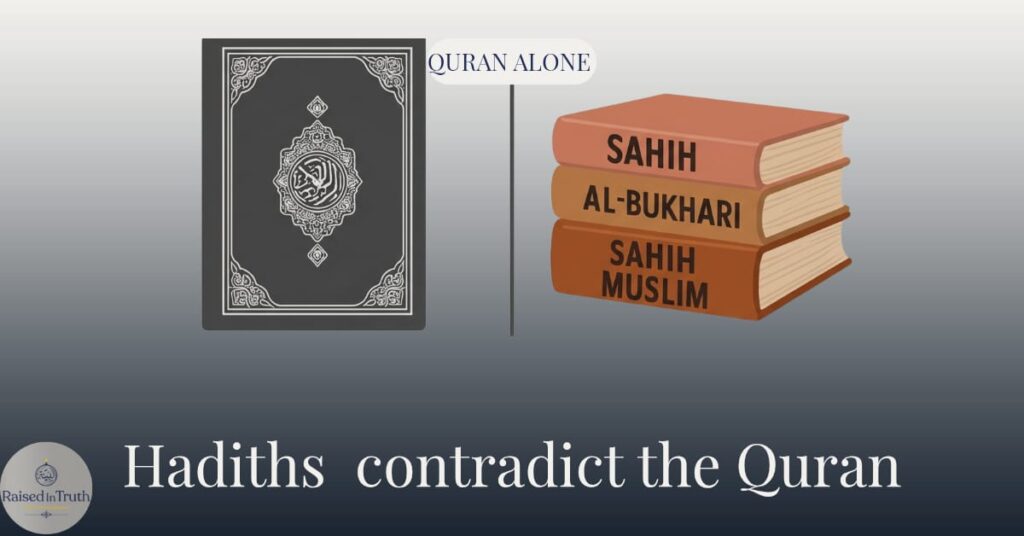
This article explores clear contradiction between Hadiths vs Quran, comparing specific verses with narration that introduce different laws, beliefs, and practices. If the Quran if fully detailed, what happens when other sources say something else?
Most Muslims are taught that Hadiths are an essential explanation of the Quran. We are told they add clarity and provide the details Allah “left out.” But as I began to study the Word of Allah for myself, I had to confront a disturbing reality: What happens when Hadiths don’t explain the Quran, but actually contradict it? Hadiths vs Quran
If the Quran is “fully detailed” (6:114) and “as clarification for all things” (16:89), then any narration that adds a new law or cancels a Quranic one is a challenge to Allah’s authority. (Read here: The Quran is sufficient)
People say: “We follow the Quran first, and only Hadiths that don’t contradict it.”
That sounds logical.
But when you actually look at how religion is practiced today, that statement doesn’t hold.
Because the foundation itself is not coming from the Quran.
Here are the biggest lies and contradictions found in the Hadith collections compared directly to the Word of Allah.
Clear Contradictions Between Hadith vs Quran
1. Freedom of Faith vs. The Death Penalty
The Quran says:
2:256
“There is no compulsion in religion. The right direction is henceforth distinct from error.”
The Hadith says:
Sahih Bukhari 6922
“Whoever changes his religion, kill him.”
The Contradiction:
This is perhaps the most famous contradiction. The Quran establishes a fundamental human right: the freedom to believe or disbelieve. Allah says faith is a choice. The Hadith, however, introduces a “death for apostasy” law. If Allah wanted a death penalty for leaving Islam, He would have put it in the Book. By following the Hadith, you are following a law that uses violence to override a Quranic right.
2. Adultery: Divine Mercy vs. Stone-Age Rituals
The Quran provides a clear, specific legal punishment for adultery. It is a harsh punishment, but it has limits.
The Quran:
“The woman and the man guilty of adultery or fornication, flog each of them with a hundred stripes.”
24:2
The Hadith:
“The Messenger of Allah sentenced a person to stoning to death… and we stoned him.”
Sahih Muslim 1691
The Contradiction:
The Quran provides a specific, clear punishment of 100 lashes. There is no mention of stoning (Rajm) in the entire Quran. In fact, stoning is mentioned in the Quran as a practice of disbelievers against the Prophets. Hadith scholars added stoning for adultery for married people, claiming that a “verse of stoning” was originally in the Quran but was “eaten by a sheep” and lost. To believe this is to believe that Allah failed to protect His Book and that a sheep is more powerful than Allah’s promise to guard the Message.
3. Marriage: Sound Judgment and Consent vs. Child Marriage
The Quran treats marriage as a “solemn pledge” between mature individuals, while Hadith-based traditions often reduce it to a contract that can involve children.
The Quran (Maturity):
“And test the orphans [in their abilities] until they reach the marriageable age. Then if you perceive in them sound judgment, release their property to them.”
4:6
The Quran (Consent):
“O you who have believed, it is not lawful for you to inherit women by force…”
4:19
The Hadith:
Narrations claiming the Prophet married Aisha when she was six years old and consummated it at nine.
Sahih Bukhari 5134
The Contradiction:
The Quran explicitly ties the “marriageable age” to the possession of sound judgment (Rushd). Allah requires the same level of maturity for marriage as He does for managing property. Furthermore, Allah forbids taking women “by force”—and a child, by definition, lacks the capacity to give legal or mental consent. This is a direct contradiction between a Divine law of protection and a human narration that ignores maturity and will.
👉 [Read the full investigation: The Truth About Marriage, Consent, and the “Aisha” Deception here]
4. Knowledge of the Unseen
One of the most dangerous shifts in traditional Islam is the elevation of the Prophet to a supernatural being who knows the future.
The Quran:
“Say (O Muhammad): ‘I do not possess for myself benefit or harm… nor do I know the unseen.'”
7:188
The Hadith:
“The Prophet was given the keys of the treasures of the earth… and he saw what would happen until the Day of Judgment.”
Sahih Bukhari 6604
Later edit:
Yes, Allah can reveal knowledge for His messengers, but the Quran clearly says that the Hour is known only by Allah and will come suddenly and no one knows its timing.whu
“The knowledge of the Hour in know only by Allah”
31:34, 7:187
While Hadiths discuss many specific signs before the Judgment Day. (7121)
The Contradiction:
The Quran defines the Prophet as a human messenger whose only miracle was the Quran itself. Allah repeatedly commands him to admit his limitations. Yet, Hadith literature is filled with “prophecies” and supernatural claims that turn him into a fortune-teller. This shifts the focus from the Message to the Man, which is exactly how previous religions were corrupted.
5. Intercession: Direct Connection vs. The Safety Net
The Quran is a book of warning: you are responsible for your own salvation. No one can help you if you fail to stand before Allah with a pure heart.
The Quran:
“O you who have believed… spend from that which We have provided for you before there comes a Day in which there is no exchange and no friendship and no intercession.”
2:254
The Hadith:
“Every Prophet had a prayer that was answered… and I have kept my prayer as intercession for my Ummah on the Day of Resurrection.”
Sahih Bukhari 6304
The Contradiction:
The Quran removes all intermediaries. It tells us that intercession is only by Allah’s permission and never a “guarantee” for a specific group. Hadiths, however, create a “safety net” where people believe that as long as they follow the “tradition,” the Prophet will pull them out of Hell. This leads to spiritual laziness and a total rejection of the Quran’s message of personal accountability.
6. Justice and Personal Responsibility
Allah’s justice is absolute. You do not suffer for my mistakes, and I do not suffer for yours.
The Quran:
“And no bearer of burdens will bear the burden of another.”
6:164
The Hadith:
“On the Day of Resurrection, Allah will deliver to every Muslim a Jew or a Christian and say: ‘This is your rescue from Hellfire.'”
Sahih Muslim 2767
The Contradiction:
This Hadith suggests a “scapegoat” system where innocent people are thrown into Hell to save Muslims. This is not justice; it is tribalism. It directly violates the Quranic principle that every soul is responsible for its own deeds.
7. Clear Wudu vs. Ritual Complexity
The Quran:
“O you who have believed… wash your faces and your forearms to the elbows and wipe over your heads and wash your feet to the ankles.”
5:6
The Hadith:
Includes washing the mouth, the nose, the ears, and specific numbers of repetitions (three times each).
Bukhari 159
The Contradiction:
Allah gave a 4-step instruction for Wudu. It is simple, clean, and direct. Hadiths have turned this into a complex 10+ step ritual. While people say “it’s just extra good deeds,” the reality is that many Muslims believe their prayer is invalid if they don’t wash their nose or ears—even though Allah never asked for it. By adding to Allah’s law, you are saying Allah’s instructions were “not enough.
8. Food Restrictions: Divine Simplicity vs. Endless “Haram” Lists
The Quran provides a short, clear list of forbidden foods, focusing on what is actually harmful. The Hadith system, however, has created an endless list of prohibitions that turn daily life and nutrition into a source of constant anxiety.
The Quran:
“Say, ‘I do not find within what was revealed to me anything forbidden to one who would eat it unless it be carrion or blood poured forth or the flesh of swine…’”
6:145
The Hadith:
“The Messenger of Allah forbade the eating of every wild beast of prey with fangs and every bird with a talon.”
Sahih Muslim 1934
The Contradiction:
Allah explicitly states that He does not find anything else forbidden except those 4 categories. By adding fangs, talons, and complex rules about processing or specific animals, the Hadith system establishes control through the stomach. It makes the simple act of eating—something Allah intended to be easy—a minefield of “Haram” labels that have no basis in the Revelation.
9. Images and Art: Creativity vs. Fear
The Quran:
“They made for him (Solomon) what he willed of elevated chambers, statues, bowls like reservoirs, and fixed cooking pots.”
34:13
The Hadith:
“The people who will receive the severest punishment from Allah on the Day of Resurrection will be the picture-makers (artists).”
Sahih Bukhari 5950
The Contradiction:
The Quran mentions statues being made under the authority of Prophet Solomon without condemnation. Yet Hadith literature turns image-making into one of the gravest sins. This creates a religion where creativity is feared instead of appreciated. How can something described as part of a blessing in the Quran become a cause for severe punishment? This shift replaces a balanced view of human expression with a culture of fear around art and imagery.
10. Intimacy and Consent: Mercy vs. Obligation
The Quran sets boundaries for marriage rooted in mercy, while Hadith literature often treats a woman’s body as a service that must be available regardless of her physical or mental state.
The Quran:
“And of His signs is that He created for you from yourselves mates that you may find tranquility in them; and He placed between you affection and mercy.”
30:21
“They ask you about menstruation. Say, ‘It is a discomfort, so keep away from women during menstruation…’”
2:222
The Hadith:
“If a man calls his wife to his bed and she refuses, and he spends the night angry with her, the angels will curse her until the morning.”
Sahih Bukhari 3237
Narrations allowing intimacy during menstruation except intercourse. (I will not add this vile hadith to my blog, you can search for it yourself if you want)
Bukhari 302
The Contradiction:
The Quran uses the word “discomfort” (adhá) to protect the woman, giving her space and dignity during her period. The Hadith system does the opposite: it removes her right to say “no” by using psychological warfare (the threat of angels’ curses) and minimizes the divine boundary of “keeping away” to just one specific act.
This reduces marriage from a bond of “mercy and affection” (30:21) to a contract of forced availability, where a woman’s physical discomfort is ignored in favor of a man’s desire.
11. Menstruation: Biological Reality vs. Religious Exclusion
This is where the Hadith system turns a natural biological process into a reason to “cut off” women from their Creator, claiming they are spiritually lesser because of their biology.
The Quran:
“They ask you about menstruation. Say, ‘It is a discomfort, so keep away from women during menstruation…’”
2:222
The Hadiths:
“I have not seen anyone more deficient in intelligence and religion than you (women)… she can neither pray nor fast during her menses.”
Sahih Bukhari 304
The Contradiction:
The Quran only addresses menstruation in the context of intimacy, not worship. There is no command to stop prayer or disconnect from Allah. However, Hadith literature introduces the idea that women cannot pray or fast and even labels them as “deficient in religion.” This effectively removes a woman’s direct connection with Allah for a significant portion of her life—something the Quran never commands. What is described as a natural biological state becomes a reason for spiritual exclusion.
12. Fasting: Until Night vs. Until Sunset
The Quran:
“…Then complete the fast until the night (Al-Layl).”
2:187
The Hadith:
“The people will remain on the right path as long as they hasten the breaking of the fast (at sunset).”
Sahih Bukhari 1957
The Contradiction:
One of the most visible ways the Hadith system has altered Allah’s timing is by changing when the fast actually ends. The Quran clearly sets the endpoint of fasting as “the night” (Al-Layl). However, Hadith teachings encourage breaking the fast immediately at sunset. This creates a subtle but important shift: instead of following the exact wording of the Quran, people are following an adjusted timing. When divine instructions are precise, even small changes raise a serious question—are we following what Allah said, or what was later interpreted and enforced?
13. Fasting Exemptions: Defined Limits vs. Added Categories
The Quran:
“…And whoever is ill or on a journey—then an equal number of other days. Allah intends for you ease and does not intend for you hardship…”
2:185
The Hadith:
“Allah has relieved the traveler of half of the prayer, and He has relieved the traveler, the pregnant woman, and the breastfeeding woman of the fast.” — Note: Other narrations also add menstruating women.
Sunan an-Nasa’i 2274
The Contradiction:
Allah clearly defines who is exempt from fasting: the sick and the traveler. The list is simple and precise. Hadith literature expands this list by adding more categories, implying that Allah’s original command required adjustment. This raises a fundamental question: if Allah created women and understands their conditions, why would He leave out such essential details? Adding categories to divine law suggests that human interpretation is correcting what was already declared complete. Women who are sick during these periods are naturally excepted by Allah from fasting.
Conclusion: When “More” is Not Guidance
When I looked at these contradictions, what stood out to me was not just a difference in details, but a difference in direction.
The Quran consistently speaks with clarity about direct accountability before Allah and about limits that are never crossed when it comes to divine authority. The Quran consistently speaks in a way that is clear, balanced, and rooted in responsibility, mercy, and direct connection with Allah. It sets limits, but it does not suffocate. It gives guidance, but it does not overwhelm.
Then you look at what was added later:
- More rules
- More restriction
- More fear
- More dependence on systems and intermediaries.
Slowly, without even realizing it, the simplicity of the message gets buried under layers of human interpretation. What shocked me the most was not just the contradictions themselves, but how normalized they are. People defend them without ever going back to the source to check.
We are told: “Follow both.” But when the two don’t say the same thing… what are we actually following?
This is not about rejecting everything blindly. It’s about being honest enough to compare, reflect, and take responsibility for what we choose to follow. Because at the end of the day, no one will stand there with you.
Not scholars. Not traditions. Not generations before you. Only you, and what you chose to believe.
For me, that journey brought me back to something simple: If Allah says the Book is complete, clear, and fully detailed… then I have to take that seriously. Not emotionally. Not culturally. But logically.
And once you see it, it becomes very hard to unsee.
In my next article, I will explain why this deception is so hard to break and how the “scholars” have used fear and tradition to keep the truth hidden for centuries. I call it “The Great Deception.
Now I’m curious:
- Which of these points surprised you the most?
- Is there something you would add to this list that you discovered yourself?
Leave a comment below. Let’s discuss the foundation of our faith.
Thank you for this great eye opener!
You’re welcome! I’m glad it helps! 🤍
Pingback: How Was the Quran Preserved? The BIG Lie Of Hadiths Transmission - Raised In Truth