
I’ve been taught to fear childbirth for most of my life.
This is the story of my first home birth with my third baby. After two hospital births, I wanted to give birth at home, but I didn’t expect to experience 4 or 5 days of prodromal labor before my actual labor began. I’ll share why I chose a home birth, how labor unfolded, what I prepared, what recovery was like, and what this experience taught me about fear, control, and trusting God.
I thought choosing a home birth would mean taking back control of my birth. Instead, I learned that I could prepare for the birth, but I could never control exactly how it would happen.
If you don’t want to read the whole story, you can jump to any section below:
- Why I Feared Birth
- Home Birth vs Hospital Birth
- Entrusting my third pregnancy to God
- Home Birth in Romania: Why It Was Difficult to Arrange
- Why I Started Feeling Like I Had to Give Birth Before 40 Weeks
- What Is Prodromal Labor? My 5-Day Experience
- My Positive Home Birth Experience
- My Baby After Birth
- Home Birth Supplies: What I Actually Prepared
- My Placenta and Recovery After Home Birth
- The Hardest Part of My Home Birth Was Actually the Older Children
- Home Birth Was a Filter for Friends
- What I Actually Learned From This Birth
- Conclusion: Learning to Trust God
Why I Feared Birth
I was taught that birth is something that needs to happen in a hospital, with a doctor, because there are too many things that can go wrong otherwise. And in Romania, where I live, almost every woman I knew gave birth in a hospital. I had never personally known anyone who had given birth at home.
But after having my first two children in the hospital, I started looking at birth very differently. I started to learn more about home birth and prepare myself. I knew this was what I wanted for giving birth. I knew that trusting in God’s creation is the way.
I knew that birth was not a sickness. It is a physical process that God created a woman’s body to go through. And I started to feel that it was important for women to know that they are capable of giving birth. In a hospital or at home, only the woman is giving birth, not the doctor or anyone else. They are there to provide support or intervene when something isn’t going as it should (and those cases are rare; many complications arise from fear).
That doesn’t mean that there are no risks or that medical help is never necessary. It doesn’t mean that every woman should give birth at home; it means that every woman should trust God, her body, and her instincts.
For me, it meant that I wanted to embrace birth as God created it, trusting Him (but I had my struggles; you’ll see later…).
Home Birth vs Hospital Birth
My first two children were born in a hospital, and there were several things about those experiences that I knew I didn’t want to go through again.
- The position. In the hospital, I could only give birth on the gynecological chair. It worked completely against gravity. During both of my previous births, my contractions slowed down or stopped when I was put into that position, and I tore during both births.
- My baby was taken away after the birth to be cleaned while I’ve been stitched.
- The placenta. After delivery, the placenta was pulled (this is also not normal; the placenta should also be delivered through expulsion, driven by a contraction), and the staff used their hands or instruments to check that nothing remained inside.
- The umbilical cord was cut immediately and the hardest part it was that
- They took my baby again for at least 2 hours after birth. After they stitched me and moved me from the chair to the bed, they brought my baby back so I could nurse him for about half an hour. Then they took him away again as they moved me to another room. I waited at least two hours before he was returned to me. That was my painful part for me. All I wanted after birth was to keep my baby in my arms, and this was the biggest reason for me to home birth.
- A lot of pressure because I DID NOT VACCINATE my baby. With my second child, this was another part of the hospital experience that was very difficult for me.
I had decided not to vaccinate him. And the staff treated me as if I was doing something terrible to my baby. I was told that I wasn’t giving him a chance by not vaccinating him, including when it came to vitamin K. They insisted a lot, saying all kinds of things, trying to make me change my decisions.
Birthing in Romanian hospitals meant giving up too many decisions, losing control of my own body and my baby, and this time I couldn’t accept that anymore.
All these things made me want to home birth so much, even though I didn’t have any idea how it would be, I knew I could do it if God wills it.
Entrusting my third pregnancy to God
By the time I became pregnant with my third child, my approach to pregnancy had changed quite a lot. After I decided not to vaccinate my second child, our whole approach to health had changed. We decided to give up medicine and use doctors only in some particular cases. So I chose not to have pregnancy blood tests or other routine analyses at all. I didn’t do any, and I didn’t take any prenatal or folic acid during this third pregnancy; I chose to trust God instead.
He was the One who gave me this pregnancy, so I chose to entrust it to Him.
Sometimes fear leads us to trust doctors more than God, but the truth is that God alone gives and takes life.
The only ultrasound I had was at 18 weeks because I needed it for some paperwork for my prenatal leave. I had to prove how far along I was in my pregnancy, so I had to have an ultrasound.
That was also when I found out the sex of the baby. We were told she was a girl, although I wasn’t 100% sure until the end that she would actually be a girl.
Choosing a home birth wasn’t one completely separate decision. It was part of a much bigger change in the way I was looking at pregnancy, birth, health, and the way I wanted to care for my family.
Home Birth in Romania: Why It Was Difficult to Arrange
Home birth in Romania isn’t easy to arrange. Here, women are not forbidden from giving birth at home, but it’s forbidden for a trained professional to assist a home birth. So it’s forbidden for a trained midwife or Doula to assist women at home, forcing them to either give birth unassisted or accept the system’s conditions at hospitals. That sounds like forcing the hand of women, that’s the system… whatever.
The trained professionals who go through the system are asked to sign that they will not assist with a home birth; otherwise, they lose their license and can’t work anymore anywhere as midwife or Doula.
So technically, a woman can give birth at home, but practically, finding someone trained and experienced in home birth who can come to your home and know what to do if something goes wrong is extremely difficult.
I could find only four doulas in the whole country who seemed to be an option for a home birth, and finding the right person was not easy, I can tell you.
At first, I wanted another Doula, but she lived too far away.
Then I contacted another Doula, but I didn’t resonate with her at all. She came much more from the medical system and was quite imposing with her conditions. She wanted certain tests and analyses that I didn’t agree with, and she had other conditions for attending the birth that I didn’t feel comfortable with.
Then, during the last month of my pregnancy, I found the Doula who eventually attended my birth.
But there was a condition: she could only attend until I was 40 weeks pregnant because after that she had to leave the country. And I didn’t have another Doula who could take over as a backup. So my only backup plan after 40 weeks was the hospital.
I wanted so much to give birth at home and avoid the hospital that I was ready to do it at home unassisted, but my husband wasn’t okay with that; he was worried, being new to this whole idea for him.
And this created a lot of pressure in my mind. I wanted the home birth very badly.
I started thinking about the 40-week point almost like a deadline. I told myself that if I gave birth after 40 weeks, then God had chosen the hospital for me. And if I gave birth before 40 weeks, then God had allowed me to have the home birth I wanted.
I said that I trusted God, but at the same time I was constantly thinking about when the birth would happen, how it would happen, how long it would take, and whether I would manage to have the birth I wanted.
Looking back, I can see that I was trying to control something I couldn’t actually control. I struggle to let go of control (this is a huge weakness of mine).
Why I Started Feeling Like I Had to Give Birth Before 40 Weeks

My first two children were both born in winter, and both were born on Wednesdays.
My daughter was born at 39 weeks and 1 day. My son was born at 39 weeks and 2 days. So when I was pregnant with my third baby, who I thought was going to be a girl, I expected her to be born exactly like my daughter. I thought she would come at 39 weeks and 1 day, which would mean another Wednesday.
I had made all these plans and expectations around how the birth would happen. But birth doesn’t really work that way. Each birth is different, and you can’t predict exactly when or how it will happen.
Another thing affected my expectations.
When I chose home birth and started talking to the few doulas who were available in Romania, they all talked about how beautiful and empowering home birth could be. And because of that, I started expecting my third birth to be super easy, super fast, and much less painful.
I somehow forgot how painful my first two births had actually been.
My first labor had lasted around 7 hours, with about 5 hours of strong labor.
My second labor had been around 4 hours, with about 2 hours of strong labor.
So I thought my third one would probably be even faster.
I also had prodromal labor (I will tell you in a minute what it is, if you don’t know), and I read that prodromal labor can sometimes be followed by a very fast active labor.
There was even a mother in a Facebook group who told me that she had experienced prodromal labor before her third baby and then her active labor was only about 45 minutes. So that became another expectation in my mind. I thought this birth was going to be very fast. It wasn’t.
What Is Prodromal Labor? My 5-Day Experience
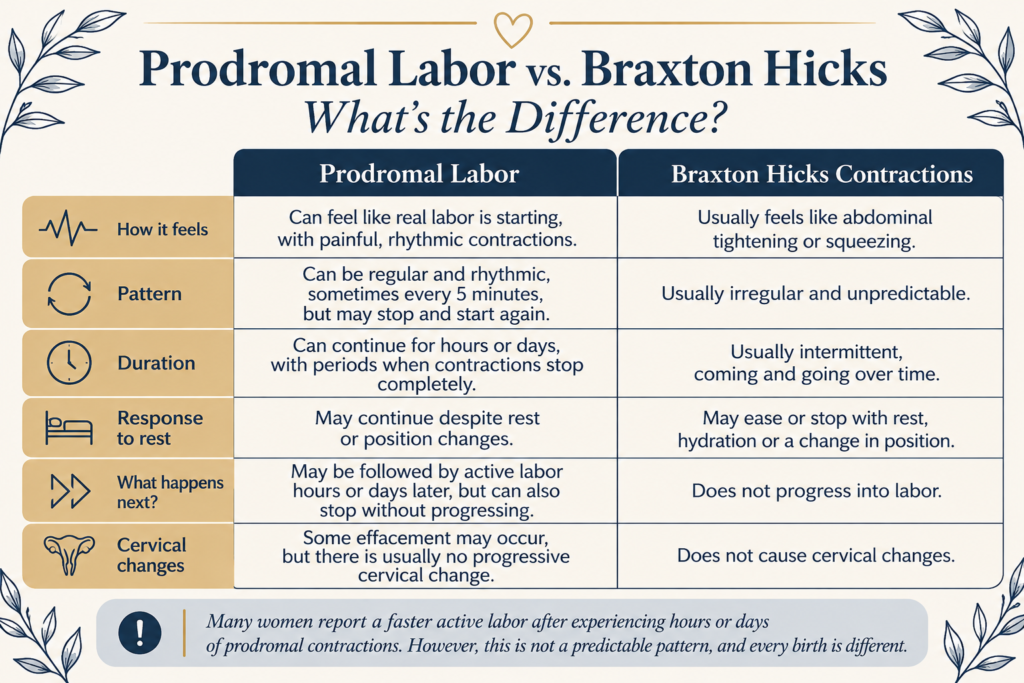
First of all, what is prodromal labor?
Prodromal labor is a type of false labor contraction. It happens in the third trimester of pregnancy and can feel a lot like real labor. Unlike real labor contractions, prodromal labor contractions never get stronger or closer together and don’t lead to dilation. (Source here)
My experience
I didn’t know about this, even though I thought I knew almost everything there is to know about pregnancy.
At 39 weeks and 2 days, I started having contractions that were coming about every three to five minutes.
I thought it was real labor.
I called my Doula, and she came from another city. It took her about an hour and a half to get to me. The contractions continued throughout the night, but in the morning, they stopped.
My Doula stayed another day because we thought maybe they would start again. They didn’t. So she went home and planned to come back when the real labor started.
I started researching what had happened, and that’s when I learned about prodromal labor.
The contractions were real. They were painful. They weren’t just Braxton Hicks contractions.
They could feel like the beginning of real labor, with contractions starting and becoming regular, and then everything would stop.
And this happened to me for about four or five days. It was exhausting.
The contractions would start and stop during the day, sometimes at night, and I always had to stay alert because I didn’t know when labor was actually going to begin.
I couldn’t really go far from home because I was always thinking that maybe this was finally it.
How long does prodromal labor last?
For me, it lasted about 5 days
According to this source, it depends on pregnancy, can start around 37 weeks and last up to several days and according to this source, it can go on for days or weeks.
After 5 days of this, I reached exactly 40 weeks. And then, around 5 in the morning, the contractions started again.
At first, I wasn’t sure if this was actually labor or if it was going to stop again. But by around 8 a.m., the contractions were getting stronger. So I called my Doula again. This time, it was real.
Note: Looking back, those days (the Doula stayed for two nights and a day) were exactly what we needed to get to know her before this intimate moment; she was liked by my children, and I had time to talk and go for walks with her.
Everything happens for a reason, and God’s plan is truly far better than anything we could plan ourselves. Thank God!
My Positive Home Birth Experience
The strong contractions started around 8 a.m. I moved around as I liked in my home. When they started to be really painful, I moved in my bathtub with some towels to feel comfortable, and I moved in my bathtub with every contraction, as I felt it was better for me.
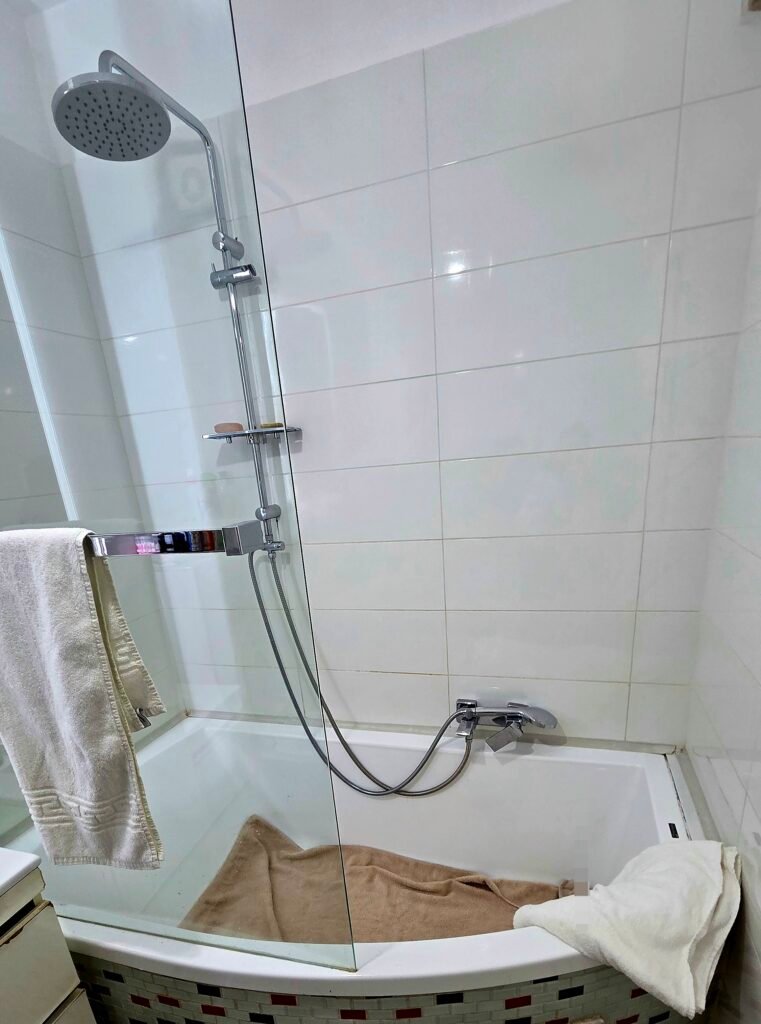
I gave birth at 11:30 a.m.
So my labor at home was around three and a half hours. It wasn’t extremely long, but it definitely wasn’t the super-fast birth I had imagined. And the pain was not magically easier because I was at home. It was painful. It was as painful as my previous births.
I reached the same point I had reached during my other births where I thought, I don’t want any more children. I remember thinking Why do women do this? I don’t want to do this anymore. I don’t want anymore babies (I don’t know about you, but in every birth I did have this tough with just a few contractions before the expulsion 😅)
At some point, I was very close to giving birth, but I still didn’t feel the urge to push.
The contractions were extremely strong.
I had prepared a comb to hold during contractions because I had heard that it could help, but I didn’t even use it.
I mostly just wanted to focus on the contractions, feel them, and get through each moment.
At first, I didn’t want to use water either.
I was worried about the baby getting water in her mouth, and I didn’t really like the idea of giving birth in the water. But when the contractions became extremely strong, my Doula suggested adding some water to help me.
So I put some water in the bathtub.
It wasn’t enough for me to actually give birth in the water. It was mainly enough to wet and warm my legs and body and help me relax a little. And almost immediately after I felt the warm water on my body and legs, I entered the pushing phase. And then I gave birth.
My baby was in my arms, thank God.
And just like with my previous births, the moment I saw my baby, the feeling that I didn’t want any more children disappeared.
The pain was gone from my mind. I had already forgotten about it.
My Baby After Birth
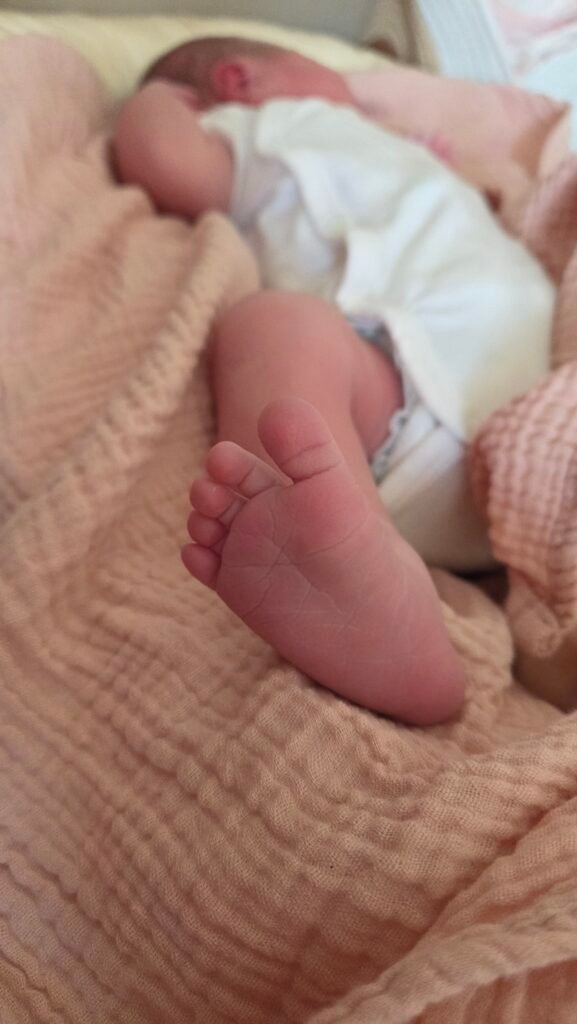
So, as I said, I was on my knees in my bathtub in the expulsion phase, and my Doula caught my baby in 2-3 contractions. I turned around and sat down in the bathtub, and she gave me my baby. She cried immediately. I gently rubbed her back; she was fine, thanks to Almighty God.
She was born weighing 3.53 kg (~7.8 pounds) and measuring about 50 cm (~19.7 inches)—I’m not sure about the length; it’s hard to measure a newborn precisely.
She didn’t nurse immediately; I was just holding her skin-to-skin, and she calmed down on my chest. We delayed cutting her umbilical cord until it was no longer pulsating, around 20-25 minutes (I know it’s natural for babies not to nurse when they are still attached to the umbilical cord).
This time, nobody took my baby away from me.
She did nurse later when I moved to the living room, after I cleaned a little bit and got dressed.
Besides the first 2 days, when she was attached to the boob (on the day, at night she slept pretty well, I do co-sleep with all my children), she is the chillest baby.
In the first 2 days, I was scared that she would be like my daughter (being a baby girl as well) and that she would be a colicky baby (if you want to know more about my colicky baby experience and what I think helped a lot this time, write down below in the comments and subscribe to let you know when I post a new article about it), but I barely knew her cry. She doesn’t cry or sleep for long, but she eats and sleeps. I never believed that babies like this really exist 🫢🩷.
I did have breast engorgement, and I dealt with producing too much milk (like in all my previous breastfeeding journeys), but this time I dealt with it from the start with sage tea (you should be very careful if you want to use it, as it can stop lactation) and breastfeeding for 6- 8 hours on one side to reduce it. And like all my children, I can’t eat any products with milk. So solving these 2 problems solved a lot of crying and stress — things I didn’t know with my first daughter, and I thought she was just colicky until around 6-7 months (colicky doesn’t actually exist, but they just don’t know why the baby is crying; the baby is crying because it is in pain and something is not ok; babies don’t cry for no reason; for me, it was these 2 problems).
Thank God, having a 3rd baby is indeed so much different. I do have a lot more experience.
Home Birth Supplies: What I Actually Prepared
I wanted to write a list of home birth supplies, but I’m not the right mama to do that, because I really didn’t need that much.
I also had scissors prepared for cutting the umbilical cord, which I had boiled in water beforehand.
And that was pretty much it.
The birth itself happened with what I already had at home.
My Placenta and Recovery After Home Birth
After the birth, the placenta was actually very easy. About 20 minutes later, it came out without any severe pain or intense contractions.
And the recovery was surprisingly easy too.
I didn’t bleed very much.
I didn’t tear at all.
I didn’t need stitches.
Overall, my recovery was much easier than after my previous two births.
After both of my previous hospital births, I had torn and needed to be stitched. I was still able to move around normally after about two days, but I had the tearing and the stitches to recover from.
This time, that didn’t happen. And physically, I felt that the recovery was much easier.
There was one thing that was a little more painful, though. The contractions after birth, when the uterus contracts back down, were somewhat more painful for me this time.
And I think part of that was because I was trying to do more than I probably should have.
The Hardest Part of My Home Birth Was Actually the Older Children
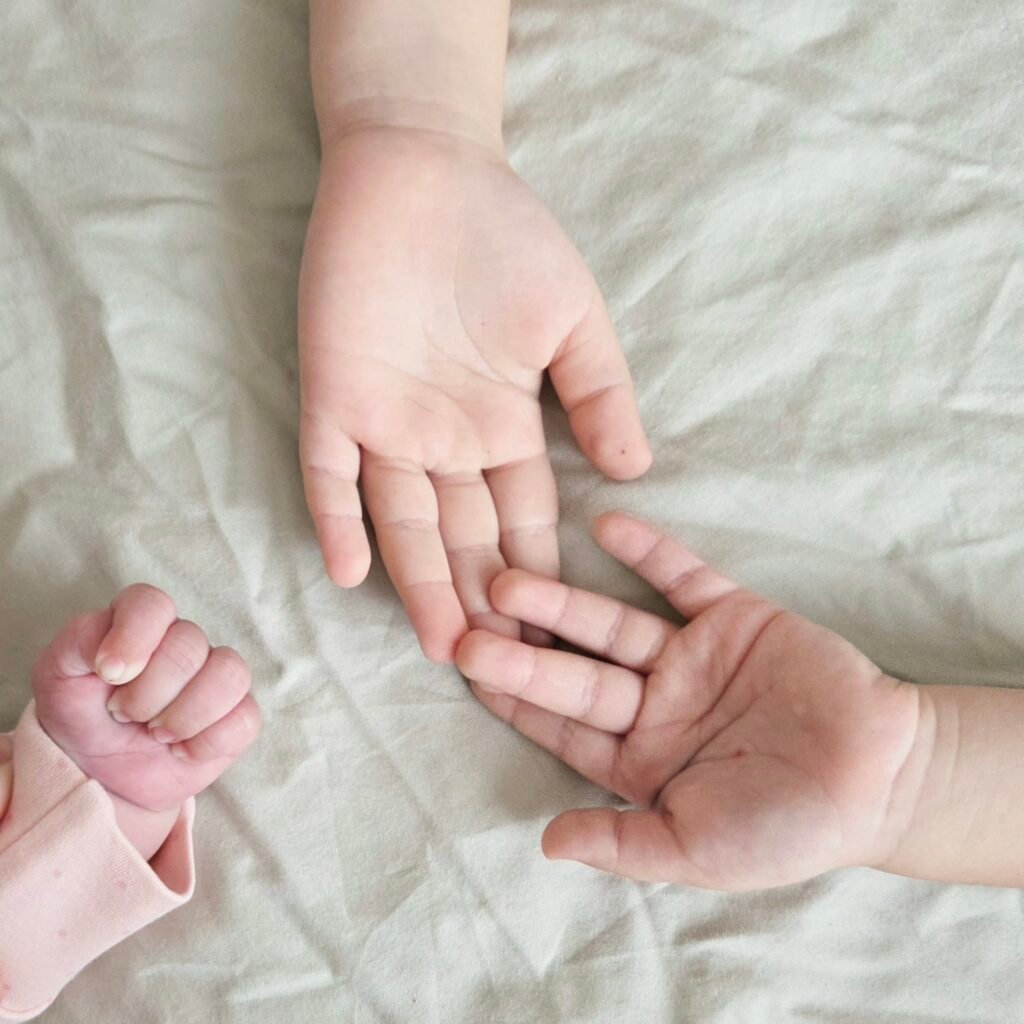
Okay, let me explain. If you have older children, homeschooling them, and have little to no help, then you know what I mean…
The hardest part of having a home birth wasn’t actually the birth itself, It was the first few days afterward, especially if you don’t have family or someone you trust who can help with your older children, this can be quite difficult.
You are postpartum. You have a newborn who wants to be in your arms and at the breast all the time; you are supposed to rest and stay in bed as much as possible.
I tried to stay mostly in bed and only got up when I needed to, like to go to the bathroom. Of course, I did move around the house because I had two older children and I was at home. It was strange for me not to pick things up off the floor or do the simple things the kids asked…
Life doesn’t completely stop just because I’ve had a baby.
For my older children, this was difficult. It was a mix of feelings for them, from excitement for the new baby to disappointment that they couldn’t play with him, that they could only gently touch her, that Mommy stayed only with the baby in her arms, and that Mommy couldn’t get all their simple requests.
There were also moments when I did more than I probably should have. I even picked up my two-and-a-half-year-old when I felt that he needed me.
I wouldn’t recommend lifting a toddler so soon after birth, but in that moment, he needed his mother, and I picked him up.
After that, I noticed that the contractions from my uterus contracting back down were a little more painful than they had been after my previous births.
But apart from that, the recovery itself was much easier.
So yeah, the first day was with lots of big feelings, lots of joy, excitement, but also lots of meltdowns and I cried together 😅, but we survived and looking back it was still so beautiful ❤️, thanks God.
Home Birth Was a Filter for Friends
I didn’t expect my home birth to teach me something about friendship too.
I’m an introvert, I don’t have friends, and gave up all my friends (all fake friends) somewhere in my first year of marriage, but past year my daughter as she grew and was Unschooling, she started to want friends so I started to connect with few moms to hang out with them and their kids to get kids to play and make friendships.
Long story short, all these moms were saying what good friends we are, that they would help me when birth came ( they knew I had no help and all the story) until I gave birth and none did. They all pretended to be wounded then 😅. So yeah, home birth is a good filter for friends.
What I Actually Learned From This Birth
I think one of the biggest things I got wrong during this pregnancy was thinking that choosing home birth meant that I had some control over the birth.
I thought about the date; I even fixed the exact gestational date: 39 weeks and 1 day.
I thought about the fact that my first two babies had both come on Wednesdays, this baby should be the same, and based on previews labor I expected a quicker labor, especially after learning about prodromal labor and also the fear with not being able to birth at home because I couldn’t have a doula for past 40 weeks.
I was making a lot of presumptions and expectations for things that were never mine to plan, schedule, or control. All of this was decided by God, and all I had to do was trust Him more and wait for things to happen naturally, as they should. I did struggle this time, to be honest, to let go of control.
I had a plan for the birth, but the best planner is God.
Saying that I trust God is easy when everything happens according to the plan I had in my head.
The harder part is accepting that I don’t actually know what is going to happen.
I can prepare myself and do everything within my power, but the results are always from God. That’s the lesson I had to learn during this birth.
Conclusion: Learning to Trust God
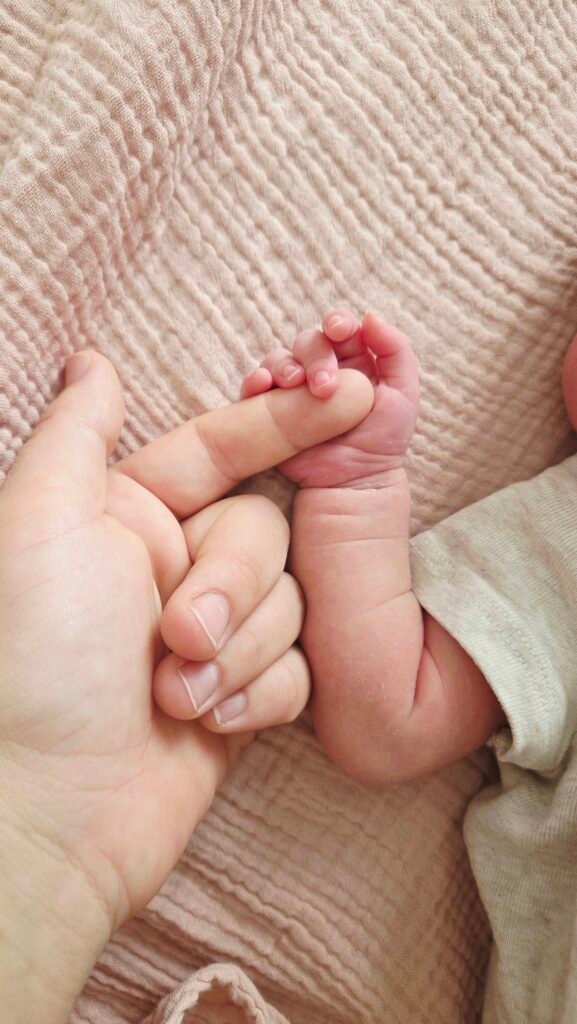
Choosing a home birth was indeed the best decision I made. Not because it was painless (it was as painful as the others), but because I could have my husband and children with me, I was in my home, not a new place, my baby was in my arms all the time and I could do everything in my peace without anyone else to dictate where/how to stay, without unsolicited advice or comments. It was exactly how I wanted in my own peace. And for that it does help to have people that trust you, people that won’t interfere unless it is necessary. And physically, the recovery was much easier than my previous births.
But the biggest lesson wasn’t about all of this; it was about letting go of control.
I thought I was trusting God, but I was still trying to predict everything.
I am thankful to God for how He planned my home birth, including:
– My husband
– Prodromal labor (this helped me relax and know the doula before birth)
– The Doula. Even though I was pressed for time, all that stress wouldn’t have existed if I had managed to entrust this whole process to God
The whole process taught me to prepare as best I could, then let the results come from God, trust Him, and accept the outcome.
Have you ever considered a home birth? Or have you had one yourself? I’d love to hear about your experience in the comments.